
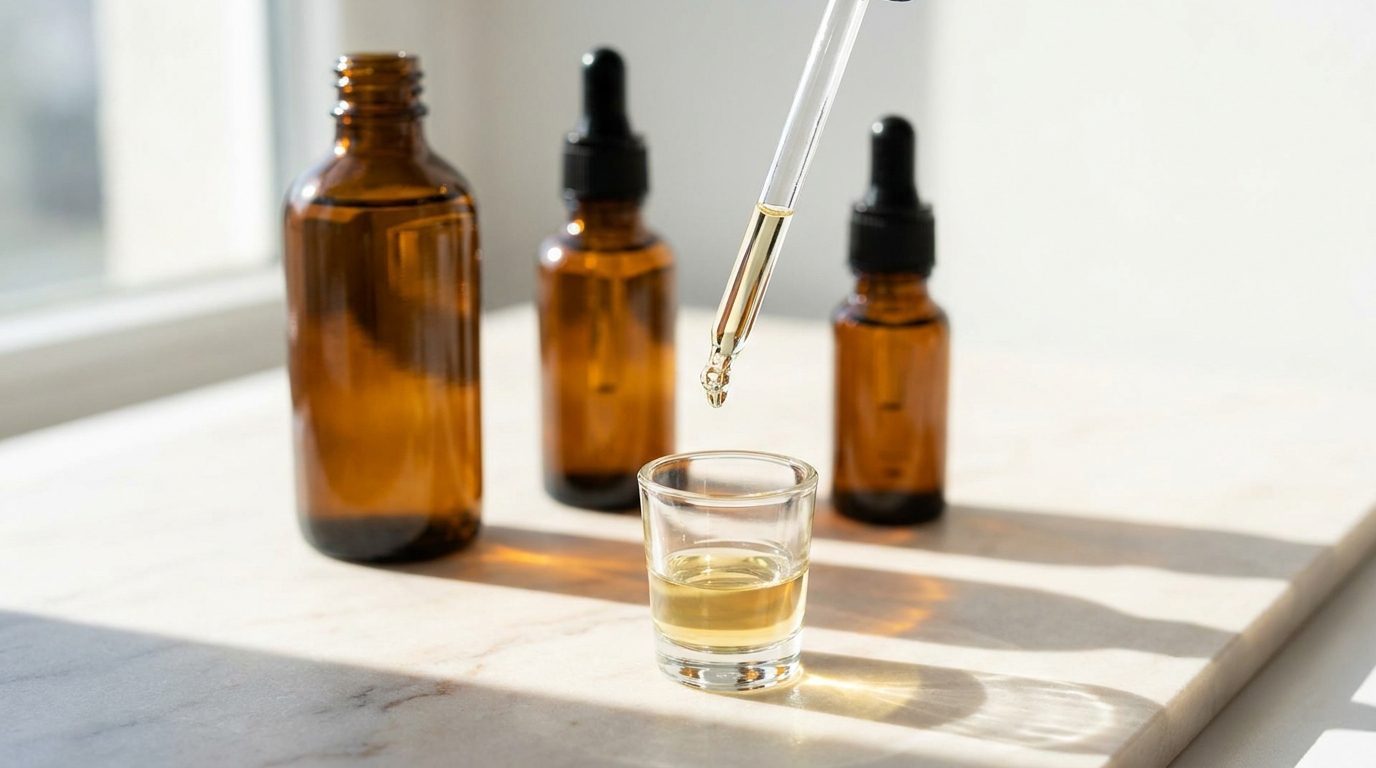
A bottle marked 1000 mg and a bottle marked 3000 mg can deliver exactly the same amount of CBD per measure. The number on the front is a total for the whole container, and until you convert it, it tells you very little about strength.
What the front-of-bottle number counts
On a CBD oil, the headline milligram figure is the total cannabidiol in the container. It is not the amount in a drop, in a full pipette, or in a day's use. It is closer to the "750 mL" printed on a wine bottle than to a per-serving nutrition figure: a statement about how much is in there in total, with no comment on how you portion it out.
That makes it an unusually effective marketing device. Bigger reads as stronger, and most shoppers compare 1000 against 600 without checking the volume each total is dissolved in. If the 1000 mg bottle holds 60 mL and the 600 mg bottle holds 30 mL, the bigger number is the weaker oil.
The one calculation that makes any two bottles comparable
Divide the total milligrams by the number of millilitres. That gives concentration, in milligrams of CBD per millilitre, and it is the only figure that lets you line two products up honestly.
| Total CBD on label | Bottle volume | CBD per millilitre |
|---|---|---|
| 600 mg | 30 mL | 20 mg |
| 1000 mg | 30 mL | about 33 mg |
| 1000 mg | 60 mL | about 17 mg |
| 3000 mg | 30 mL | 100 mg |
Then do the same for money: divide the price by the total milligrams to get cost per milligram. A large bottle with an alarming price tag is often cheaper per milligram than a small one that looks like a bargain, and occasionally it is the other way round. Both calculations take about ten seconds and they routinely reorder a shortlist.
Why counting drops is unreliable
Most oils ship with a graduated glass pipette, usually holding one millilitre when full and marked in quarters. Use the markings.
Counting drops is far less dependable than it looks. Drop size shifts with the viscosity of the carrier oil, the diameter of the pipette tip, the temperature of the room and how hard you squeeze the bulb. A thick olive-oil carrier on a cold morning behaves nothing like a thin MCT carrier in a warm kitchen. Where a label quotes milligrams "per drop", treat that as an approximation and find the per-millilitre figure instead. Metered pump sprays are the exception, since each actuation is engineered to deliver a fixed volume.
How capsules, edibles and topicals are counted differently
- Capsules and softgels are the easiest labels to read. The carton states milligrams per capsule and the count does the rest, with no measuring step and no pipette technique to get wrong.
- Edibles are labelled per piece, but the package total still matters: 200 mg spread across twenty pieces is a 10 mg piece, and the packaging is required to make that clear.
- Topicals quote a total for the jar or tube. Because you cannot control how much lands on your skin, that total describes the richness of the formulation rather than a dose, and it is not comparable with an ingested milligram in any meaningful way.
What the milligram figure will never tell you
Concentration is one attribute among several, and a confident number printed on a carton is not evidence in itself.
- Whether it counts CBD or everything. Some labels quote total cannabinoids, or a vague "hemp extract" weight, both of which produce a larger and far less useful number.
- Whether the contents match the claim. Only a batch certificate of analysis ties the printed figure to a tested lot of product.
- How much THC comes along. Full-spectrum oils legally contain a small amount, which matters to anyone who is tested at work or drives for a living.
- What the carrier is. Carrier oil changes taste, thickness, how the liquid behaves in a cold room, and how quickly it goes off.
Once you can convert a label in your head, the rest of the buying process gets simpler. The other guides in our CBD library cover lab reports, product forms and Canadian retail rules in more depth.
A habit worth adopting at the shelf
Before you compare two products, write two numbers beside each: milligrams per millilitre, and cost per milligram. Those two figures collapse most of the marketing on a CBD carton into something arithmetic. Add the batch or lot number to your note when you buy, so that if a product suits you, you can check whether the next bottle came from the same recipe, and if it does not, you have a reference point when you ask the retailer why.
This is general information about product labelling, not medical advice. Talk to a healthcare professional about your own circumstances, particularly if you take prescription medication.