
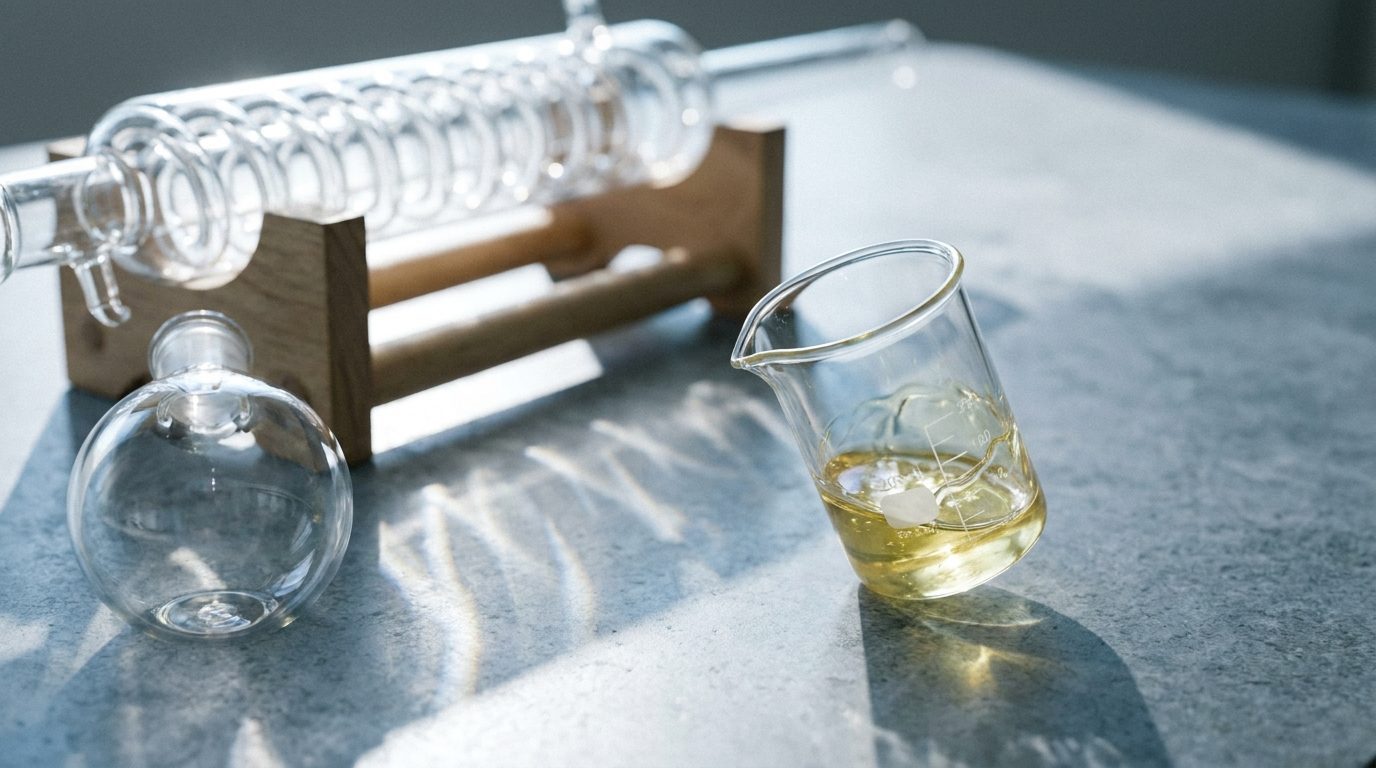
The CBD in a finished bottle never existed in that form out in the field. Getting from a standing hemp crop to a clear, measured oil takes a solvent, a heating step and usually two or three rounds of refining, and every one of those steps leaves evidence a buyer can check.
What is actually in the living plant
Hemp makes very little CBD. What it makes is cannabidiolic acid, or CBDA, built by an enzyme acting on a shared precursor compound. The same precursor feeds a different enzyme that produces THCA in drug-type cannabis, and which acid dominates is a matter of the cultivar's genetics rather than how it is grown.
These compounds are concentrated in the sticky resin glands that coat flowers and small leaves. They are not in the seed and not in the stalk fibre, which is the whole reason hemp seed oil and hemp fibre are treated so differently in law from cannabinoid extracts.
Heat converts the acid form into the neutral one, driving off a molecule of carbon dioxide in a step called decarboxylation. Producers do this deliberately, in a controlled oven or as part of the extraction process itself. It matters because the acid and neutral forms are not interchangeable, and because uncontrolled heat also degrades the very compounds being preserved.
Supercritical carbon dioxide
Held above a modest temperature and considerable pressure, carbon dioxide enters a state that flows like a gas but dissolves like a liquid. Run through milled plant material, it strips out cannabinoids and terpenes, and when the pressure drops it simply becomes a gas again and leaves.
The appeal is obvious: no solvent to purge, and a process that can be tuned by adjusting pressure and temperature to favour different fractions. The trade-offs are capital cost, slower throughput and a crude extract that still needs refining. "CO2 extracted" on a carton is a description of a method, not a certificate of quality.
Ethanol, hydrocarbons and simple oil infusion
Food-grade ethanol is the workhorse of large-scale extraction. Chilled well below freezing, it pulls cannabinoids efficiently while leaving behind more of the chlorophyll and waxes that would otherwise darken and cloud the product. It scales well and the equipment is comparatively simple, but the solvent must then be evaporated off, and whatever remains is exactly what residual solvent testing exists to find.
Hydrocarbon solvents such as butane and propane are more common in concentrates made for inhalation than in oils, and they demand rigorous purging under vacuum. At the other end of the spectrum sits simple infusion: warm plant material steeped in a carrier oil. It is the oldest approach, it is gentle, and it produces low and highly variable potency, which is why it survives mainly in home preparations rather than in labelled commercial products.
From crude extract to something you can measure
- Winterization. The extract is dissolved in ethanol and chilled so that waxes and lipids fall out of solution and can be filtered away.
- Distillation. Short-path or wiped-film distillation under vacuum separates cannabinoids from remaining pigments and volatile compounds, producing a thick, pale distillate. Terpenes captured earlier are sometimes reintroduced afterwards.
- Chromatography. Where THC has to come out, chromatographic separation is the usual tool. This is how broad-spectrum material is made.
- Crystallization. Pushed further, CBD can be crystallized into a near-pure powder, which is what isolate products are built from.
- Formulation. The concentrate is blended into a carrier oil to hit a target concentration. This is the step that sets the milligram figure on the label.
Why the method shows up on the lab report
A batch certificate of analysis is where extraction stops being an abstraction. Potency testing confirms what the formulation step was aiming for. A residual solvent panel checks that ethanol or hydrocarbons were properly purged. Heavy metal testing matters because hemp is an effective accumulator of metals from soil, so a large volume of biomass concentrated into a small volume of oil concentrates whatever the soil contained. Pesticide and microbial panels round it out. Canada's cannabis framework requires licensed processors to test against set standards, and the report is the artefact that proves it happened for your lot, not for a lot from last year. If you want the reading order for those documents, start with our other CBD guides.
What this is worth to you as a buyer
Knowing the process changes what you ask for. Instead of arguing about whether CO2 beats ethanol, ask for the certificate of analysis matching the lot number on your bottle, then check that the potency figure matches the carton, that the residual solvent panel is present and passing, and that the report is recent. A well-run ethanol extraction with clean results beats a poorly refined CO2 extraction every time, and the paperwork is the only place that distinction is visible.
This is general information about manufacturing and testing, not medical advice.